Scroll to bottom for FREE download!
Time management is one of the hardest skills for kids to master—and one of the most misunderstood.
Many children aren’t procrastinating or avoiding work on purpose. Instead, they truly don’t know how long tasks take. To a child with developing executive functioning skills, everything feels either “forever” or “five minutes.” This lack of time awareness can lead to frustration, rushed work, emotional meltdowns, and constant reminders from adults.
The good news? Time management is a skill that can be taught and practiced—and it starts with helping kids learn to ask one simple question:
“How long will this take?”
In this post, you’ll learn why time estimation is such an important executive functioning skill and how a simple worksheet can help children build realistic time awareness at home or in the classroom.
Why Kids Struggle With Time Management
Time management relies on several executive functioning skills working together, including:
- Planning
- Task initiation
- Working memory
- Self-monitoring
For many kids—especially those with ADHD, learning differences, or immature executive functioning—these skills are still developing.
Children often:
- Underestimate how long homework will take
- Overestimate how quickly they can finish chores
- Struggle to transition between activities
- Feel overwhelmed by tasks that don’t have clear time boundaries
Without explicit instruction, kids are expected to “just know” how long things take. However, time is an abstract concept, and most children require direct practice to grasp it.
The Executive Functioning Skill Behind Time Awareness
The skill at the heart of time management is time estimation.
Time estimation allows children to:
- Predict how long a task will take
- Plan their work more realistically
- Adjust expectations when something takes longer than expected
- Learn from experience
When kids practice estimating time and comparing it to reality, they begin building an internal sense of time. This skill improves gradually through guided repetition, not lectures or consequences.
Teaching Kids to Pause Before Starting a Task
One of the most powerful habits we can teach kids is to pause before beginning.
Instead of jumping into a task (or avoiding it altogether), children learn to:
- Look at the task
- Estimate how long it will take
- Complete the task
- Reflect on the actual time
This short pause supports planning, reduces anxiety, and makes tasks feel more manageable.
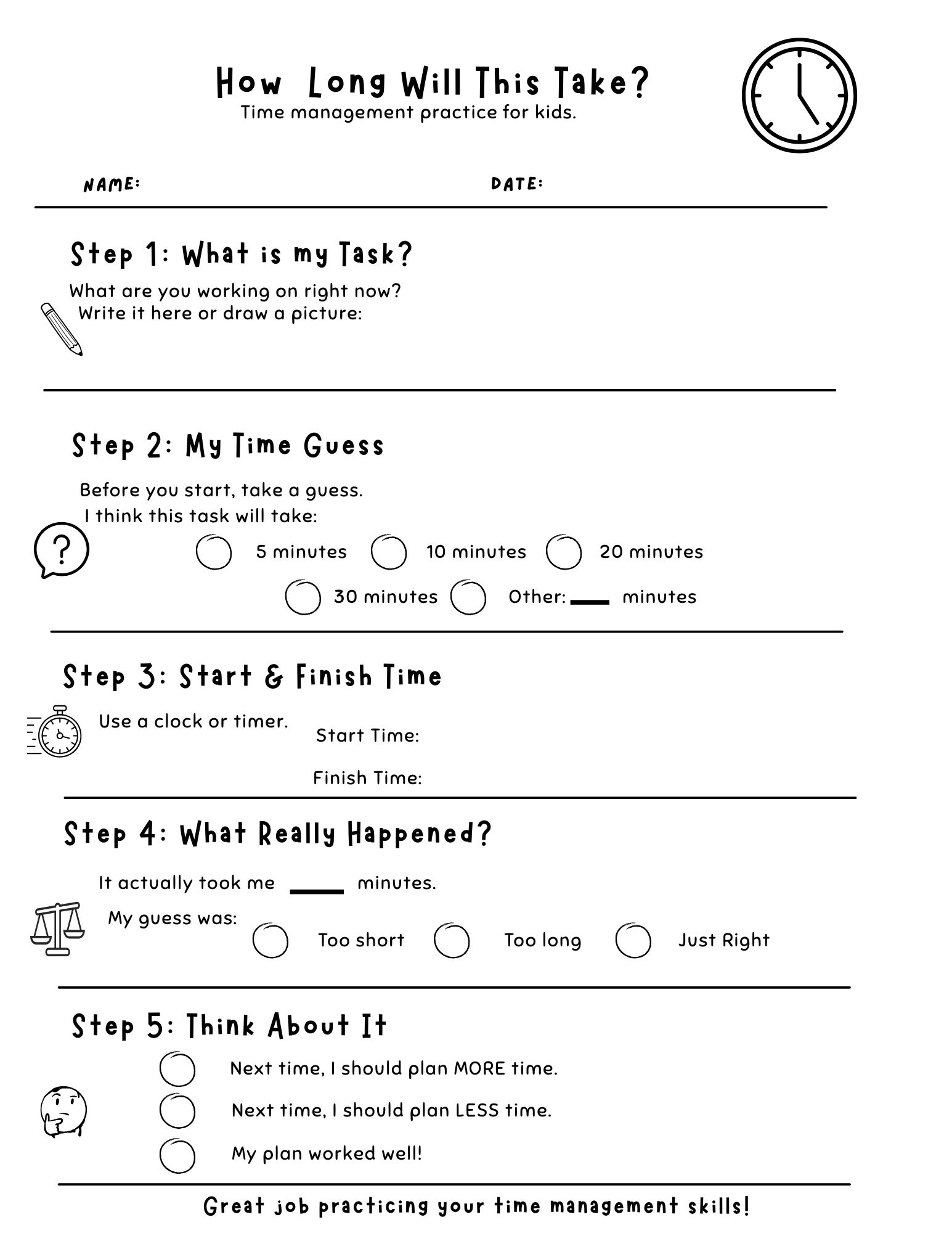
Using the “How Long Will This Take?” Worksheet
The “How Long Will This Take?” worksheet is designed to help kids practice time estimation in a simple, non-judgmental way. It works well for children in elementary grades and can be used at home or school.
- Step 1: Identify the Task
The child writes or draws the task they’re about to complete.
Examples include:
- Math worksheet
- Reading assignment
- Cleaning their room
- Getting ready in the morning
This step helps kids focus on one task at a time, which is especially helpful for children who feel overwhelmed easily.
- Step 2: Make a Time Guess
Before starting, the child estimates how long the task will take.
They might write a number or choose from options like:
- 5 minutes
- 10 minutes
- 20 minutes
- 30 minutes
Accuracy is not the goal here. The purpose is simply to practice thinking about time before beginning.
- Step 3: Track Start and Finish Time
The child records when they start and when they finish the task.
This can be done using:
- A wall clock
- A watch
- A visual timer
- A kitchen timer
This step provides concrete feedback without adult correction or pressure.
- Step 4: Compare Estimated Time vs. Actual Time
After finishing, the child records how long the task actually took and reflects on whether their estimate was:
- Too short
- Too long
- Just right
This comparison builds self-monitoring skills and strengthens future planning.
- Step 5: Reflect and Adjust
Finally, the child answers a simple reflection prompt, such as:
- “Next time, I should plan more time.”
- “Next time, I should plan less time.”
- “My plan worked!”
This reflection step is where executive functioning growth really happens. Kids begin learning from experience rather than feeling “wrong” or “behind.”
How Parents Can Use This Worksheet at Home
This worksheet fits easily into daily routines and works best when used consistently.
Try using it:
- Before homework time
- During morning or bedtime routines
- For chores or independent tasks
- When transitioning away from preferred activities
Helpful tip: Avoid correcting your child’s estimates. Let the process teach the lesson. Over time, their predictions will naturally become more accurate.
How Teachers Can Use This in the Classroom
Teachers can use this worksheet as part of:
- Morning work planning
- Independent work blocks
- Centers or stations
- Homework planning
- Executive functioning interventions
It pairs well with visual schedules, project planning worksheets, and daily check-ins. Over time, students begin planning their work more independently and confidently.
Why This Simple Practice Works
Executive functioning skills develop through:
- Explicit instruction
- Repetition
- Reflection
By practicing time estimation regularly, kids gain:
- Improved task initiation
- Reduced overwhelm
- Better transitions
- Increased independence
Most importantly, they begin to see time as something they can understand and manage—not something that controls them.
If you’re looking for an easy, effective way to help kids build time management skills, this worksheet is a great place to start.
Download the “How Long Will This Take?” Time Management Worksheet to give your child or students hands-on practice with time estimation, planning, and reflection—skills that support learning far beyond the classroom.
Terms of Use: These free worksheets are for homeschool, classroom, co-op, and personal use only. Homeschool Goldilocks free printables are never for commercial use. Thank you and enjoy!